Thursday, January 31, 2013

Everybody Wants My Fanny('s)...

Fabulous recipe for sauerkraut soup

In a former life, my in-laws were Jewish. They still are Jewish, but no longer my in-laws. My grandmother-in-law Fanny was a plump, very short sweet white haired woman who shared recipes with me. Once, back in the late '70s, she was shocked that I'd been using toothpicks to test my cakes. She made her son Terry drive her all over Sarasota, Florida to find a wire cake tester for me. I still have (and use) it today.

I still marvel at the fact that she was named Fanny at birth. It was not a nick name as far as I know. I mean, do you see your newborn emerge from the depths and suddenly think, "this one's a Fanny?" I do realize that Fanny Bryce, a Jewish Ziegfield Girl, was pretty famous at the time. Or maybe Fanny was born breech, like me? Anyway, I digress...

One of my favorite recipes of hers is for Sauerkraut Soup. Most people would never think of making soup from this unusual delicacy. But you would be amazed how delicious it is! Her recipe combines the tang and texture of sauerkraut with meat to balance it out, plus a little lemon juice and honey. I like to add dried mushrooms. Complex flavors and textures that work so well together! Every once in a while I have a craving for it. Also this summer, in my attempt to find various ways to preserve my summer's harvest, I came across recipes for making cultured vegetables. The most common one is to make sauerkraut using only a few simple ingredients: shredded cabbage, lemon juice, water. The good bacteria on the cabbage cause fermentation that turns ordinary cabbage into crunchy, tangy and super-probiotic sauerkraut.

So, what's Sauerkraut Soup without good ol' Jewish Rye bread? I used to make it regularly when I lived in Sarasota, but when I moved to high altitude Denver I gave up in exasperation. But last weekend I got brave. I found a great Hungry Mouse rye bread recipe and high altitude baking adjustments here. Sunday I pulled all of the ingredients together, spent a couple of hours mixing, kneading by hand, etc. and was ready to put my two little masterpieces into the oven. But... my gas oven would not—gasp—turn on! The stove top worked, the broiler worked, even the self-cleaning setting worked. But  it would not BAKE. Wow. With great disappointment I put my two loaves into big baggies, placed them carefully in the freezer and wished them luck.

On Monday we had an repair person take a look at the oven. It was a striker mechanism that had burned out after 15 years of use. $200 dollars later I was back in business. I took one of the frozen loaves out of the freezer and set it on parchment on a cookie sheet. I raised the sheet off the counter to allow the bread to defrost on the bottom as well as all sides. Two or three hours later it was defrosted and had risen a little more. I put some boiling water in a glass baking tray on the bottom shelf of the oven (to make up for our extremely dry air), hand-wiped the bread with raw egg mixed with water and proceeded with the baking directions. About 45 fragrant minutes later I pulled a perfectly browned loaf of bread out of the oven. It lasted about one day in my house. I just pulled the second loaf out of the oven the next morning, repeated the above and had another gorgeous loaf. They were the perfect accompaniment to the soup and also made for fantastic toast in the morning. My thanks to Fanny and the foodies on the Internet that keep me cooking and eating great food! Update: On my second batch I reduced the oil to one TB and added the raw egg/water coating to make a crisper crust and it worked beautifully!


Tuesday, November 6, 2012

Molting Chickens: It Ain't Pretty!


My chickens are about 1-1/2 years old and have stopped laying eggs, but I'm not concerned.

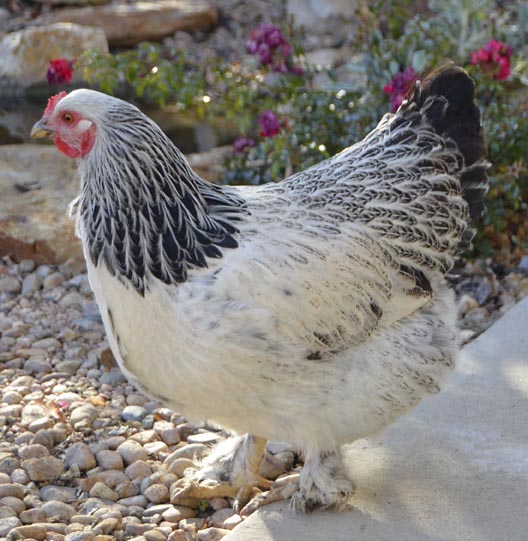
molting chicken
This is a molting chicken!
Click photo for a closer look.
You see, this is fall, when chickens molt. They are losing their old, sometimes tattered feathers and replacing them with new ones. Last year Jenny was the only one to molt and it seemed like her feathers fell out by the hundreds. Some chickens molt that way while others just lose a few dozen feathers here and there. Tiggy is also a big feather dropper. She molted early, in mid August. Flopsy and Mopsy started in early October are taking their time.

Chickens stop laying eggs (ovulating) when they're in a molt. Their bodies need to redirect that energy into making beautiful new feathers. Once they're done molting, they'll start laying again. In the meantime, I've added a little more protein to their diets to help their bodies with feather production. I've been giving them (canned) mackerel or tuna, leftover soups, meats, fish and pasta. No chicken though, I can't go there.

After the molt. Isn't Tiggy gorgeous?
Here are a couple of things I've also learned this year: When chickens are not laying eggs, their combs tend to lose color. My guess is that a chicken's comb is a "flag" to attract roosters when they're ovulating. The girls also don't "squat for the king" when I walk by, another sign they are not ovulating. Tiggy became broody early this summer, sitting in the nest box for months trying to hatch invisible eggs. Her comb also became very pale, she lost her squat and was not laying. Now she's back to normal and I'm just waiting for the rest of the girls to get their groove back! In the meantime I've been buying free range chicken eggs at the grocery story and just hoping that their definition of "free range" is in the same vicinity as mine.

January 2013 update: I was going to put a light in the chicken run after the winter solstice to get the girls laying eggs again. I figured a couple of months off duty would be enough. But to my surprise, about a week after the solstice they started laying again! I guess that teensy extra bit of sunlight kick-started their hormones.

February 2013 update: I noticed this Sunday that the girls' combs were not as bright red as they'd been lately. We were having a snow storm and they were out in the cold and blowing snow. I brought them into our sunroom for a while jus to give them a break. Pretty soon their combs were a luscious red again. So... temperature also affects comb color. 

Thursday, October 25, 2012

Run Chicken, Run!! The Danger in the Sky

This is an update to my ongoing chicken education. A few weeks ago I came home from the grocery store and decided to go out back to check up on the girls. I heard a very loud squawk from behind a tree and my white chicken Tiggy came running out with a hawk running after her. I shouted and the hawk flew up, only to perch on my 6' privacy fence just to the left of the tree. I charged him and he flew back to the fence on the other side of the tree, not wanting to leave his prize dinner behind. I have to say this hawk was about 1/3 the size of my chicken and very focused.

Abby
At this point my geriatric dog Abby stuck her head out the back door. Normally she will chase, slowly but loudly, after any intruders in our yard -- bunnies, squirrels, birds that don't live here, dogs she sees through our fence. But for some reason she didn't notice the hawk on the fence. I started yelling to Abby to "get it, get it" pointing at the hawk. He finally took his eyes off Tiggy when he saw Abby, even though she remained clueless. The three other hens were already in the chicken run (smart girls!) so I shooed Tiggy in and locked the door so I could go in the house and research hawks.

Tiggy looking fierce
Coincidentally the issue of Mother Earth News I had sitting around had an article on sky-borne dangers to chickens. They had a lot of pictures and descriptions of predatory birds, but no solutions as to how to keep them away other than locking up the chickens. Not sure what the point was of that article.

After spending about 20 minutes following leads I found through Google, I learned that (1) hawks are territorial and will not come on a property if another hawk is already there and (2) a lot of people will put up a hawk decoy for this reason.

Bird B Gone
Amazon, as usual, came to my rescue. They have a hawk decoy by Bird B Gone that was recommended by one of the articles for being pretty successful. I have free 2 day shipping with Amazon, so my decoy arrived quickly. He looks good enough to make my chickens very nervous! They recommend moving him around so he doesn't look so decoy-like, which I do. It's been two weeks now and I haven't seen a real hawk yet. Let's keep our fingers crossed!

Tuesday, September 18, 2012

Gallop Intentionally!


This is a short story about a funny, profound (or profoundly funny) statement.

My Joe.
About two weekends ago I was out at the barn riding my horse, Joe. He's a sweet and personable horse and usually pretty low key. I was done with lungeing and riding in the arena and decided to ride him around the property. He had on a bareback pad (no stirrups) and bitless bridle.

We were around the back side of the indoor arena. Inside, a couple of women were riding their horses. Joe suddenly noticed the sounds of activity, decided it was a sabre toothed tiger or something, pivoted 180° on his left front leg and took us off at a full gallop. We covered about 30' in less than a second (or so it seemed), just long enough for me to start looking for a soft place to fall. In the meantime I pulled back on the reins and shouted "whoa Joe". He stopped fairly quickly, bucked a little then settled down. I got him walking again and he acted like nothing had happened. I was amazed that I hadn't fallen off and it all happened so fast that I didn't even have time to squeak out some adrenalin (or pee). It was also nice to learn that bitless bridles work. We walked around the property for another 5-10 minutes and I decided it was time to call it a day. I took him back to the barn to untack and do the usual end-of-the-ride stuff — brushing, picking out his hooves, sharing treats.

Trail riding in Elizabeth, Colorado
Later as I was heading out, I ran into Wendy and Laurie chit chatting in the lounge area. Wendy knew what Joe had done and Laurie didn't, so I told my little story. Laurie commented that she always gallops bareback, which is very true. She and her friend Ann have Arabian horses that they've owned for years and they ride like they were born to ride. With mere bareback pads, they gallop all over the place, run up and down small ravines, even ride their horses backwards and never lose their balance. I've NEVER ridden like that!

When Laurie said she gallops bareback, Wendy looked at her very intently and asked, "do you gallop intentionally?" Laurie replied quietly yet emphatically, "I always gallop intentionally." I had to laugh at the exchange—it all looked so serious. I was also tickled by the expression, "gallop intentionally". It just sounded so profound, like "live consciously," but with more gusto. I told the girls that would be a great bumper sticker. So I went home and made one!

If you too live your life intentionally and with passion, you need one of my bumper stickers as a reminder to "gallop intentionally". They are 10"x3", waterproof vinyl, professionally printed. Click here to buy one for the amazingly low price of only $3, and postage is included! Ride like the wind, Bullseye!

Wednesday, August 15, 2012

What the HAIL was that?!? Is there life after the hail storm of the century?

Lettuce and carrots.
Infinitely more difficult to overcome than the dense clay soils of Colorado, hail storms are a common and devastating occurrence on the front range. Its not unusual to see an occasional pockmarked car, the hood, roof and trunk looking like lingering scars from heavy teen acne. Windshields break, windows and roofs are trashed, trees are denuded, vegetable and flower gardens are pulverized. I've heard of people being felled—permanently—from a serious hailstone blow to the head. I guess I can't complain. But (and to quote Pee Wee Herman, "everyone I know has a big but") I can't tell you how many times I've started plants from seeds in the dead of winter, nurtured and transplanted them into gradually larger containers, waited patiently for our last frost date (another joke), lovingly planted and finally watched with great pleasure as my garden grew. Then, just as things were looking their best, those greenish clouds would build in the afternoons. They would eventually drop, in a matter of a few riotous minutes, mothball-like ice that pulverizes and shreds everything in sight. If it's later in the growing season, there's little hope of recovery for that summer.

A couple of before/afters in my garden
A few years ago a long-time favorite nursery, Arapahoe Acres, closed it's doors after 40 years in business due to heavy hail damage. Their retail store was on S. Santa Fe Boulevard, not far from where I live. AA sold plants, garden art, pond supplies, seeds, gardening tools, just about anything a gardener or landscaper needed. Their biggest asset was acres of trees, shrubs and other landscaping plants. They were so big they had to shuttle customers around in golf carts to shop. Then one of our afternoon summer hail storms wrecked havoc on their tree/shrub farms north of Denver. The damage was so extensive it destroyed their inventory for years to come. They lost heart and chose to close their business forever. Very sad.

Squashed squash.
So, fast-forward to summer of 2012, Highlands Ranch CO. I've been very lucky for the past couple of years—hail storms either missed my garden or were mild enough to cause only minor damage. I had taken to asking Mother Nature to protect my garden at planting time, sprinkling some home-grown dried tobacco leaves as an offering ala David Elliott. But on June 7 an unheard-of midnight storm dumped hail fast and furious in our neighborhood for about 20 minutes. Our violent weather always comes in late afternoon, after the moisture buildup over the mountains finally reaches the front range and the heavy wet clouds can no longer contain their contents. Not so this time. Rare midnight lightening (so rare I've not witnessed it in my 30 years in Coloado) and violent thunder rocked our house. Our dog was beside herself. Then came the hail—hesitant at first and then loud, hard and unrelenting—elevating in strength until I wondered if our roof and windows would survive. In the back (well, actually the front) of my mind was the thought, "crap, there goes the garden". The storm let up about 1 a.m. and I fell asleep eventually, dreading what I would see in the morning.

All downspouts looked like this.
It was as bad as I expected. I looked out the bedroom window that faces our street and saw what looked like snow. The lawn was white, except for the green shards of leaves from the tree in our front yard. I went downstairs and opened the front door. Our front porch planters were filled with a couple of inches of hail and a few specks of green. The downspout in front of our garage had a mound of hail about a foot tall at its base. Heading to the back yard, the lawn was covered with hail as well. More mounds of hail below downspouts. Shredded tree leaves everywhere. The garden was pretty much gone. Our raised beds contained about 2" of hail, flecks of green showing here or there. The apple trees were tattered, the apples punctured and bruised. The lilies in our pond were in tatters.
Mustard before & after
Tomato and pepper plants were scrawny sticks bearing beat up fruit. Lettuce, collards, chard, turnips, squash, rhubarb, you name it, were unrecognizable. Never in my history of gardening had so much damage been done this early in the growing season. I didn't know if I should just turn the soil over and attempt to start again from scratch, or wait a little while and see what might survive. Our growing season is SO short that there was little I could replant that would actually produce before the end of the season. Our chickens, on the other hand, were gobbling up the hail like it was candy.

The scientist in me decided to give it a couple of weeks before I would uproot and replant. Quite a bit of my crop had been in the ground long enough to develop a decent roots, which I felt was a key to possible plant recovery. I felt that with leafy plants such as lettuce, various greens and root plants such as turnips, kohl rabi and rutabaga, there might be hope.

Recovering lettuce and carrots.
After two weeks things looked promising, after three weeks even more so. Unexpectedly, most of my tomato plants did fairly well. I attribute this to the fact that I had staked them very vertically and so weren't as damaged as they could have been. The tomatoes were so tall at planting time that I couldn't fit them into tomato cages. I used 6' tall stakes and plastic coated ties to secure their branches upwards. That resulted in them being more vertical, similar to bound Xmas trees, rather than their naturally relaxed horizontal state. Many existing tomatoes and peppers were scarred but still able to ripen; a few leaves were not shred by the hail and so were able to provide the plants with much needed sun exposure. Pepper plants did not fair as well, but did manage to re-leaf after time and start producing more fruit. Carrots were unaffected. Even my struggling rhubarb plant managed to limp along on tattered leaves and produce some new strong ones. A stevia plant that was taken to its knees managed to rebuild itself completely.

I did have to pull out a couple of tomato plants and all of the squash plants. By that time I was able to find late season substitutes that did not require a long production time to make it though what's left of summer. I found an eggplant bush at half price that was full of fruit. Basil and parsley were planted in empty spots. A couple of store-bought almost-flowering squash plants went in too. I filled a gap with beet seeds, thinking that by fall they will have sprouted and grown. They can tolerate cooler weather.

By late July the garden took on its usual overgrown, out-of-control mid-summer persona. It is not as I planned, but will still be somewhat productive. I'm glad I didn't bulldoze.

Recovery at 3-4 weeks after the storm.
I guess the hardest thing about being an urban farmer is learning to deal with whatever Mother Nature dishes out. We are not financially crushed by natural disasters like commercial farmers can be. If our crops fail, there's always farmers' markets. But it's so reassuring to know that the tender plants we put in the ground are sometimes able to heal themselves.

As a final note, it is now mid-August my tomatoes are finally getting red. It took a long time for the plants to recover and have enough extra energy to produce new fruit. However, they are also dying from Fusarium wilt. I'm not sure if they are naturally non-resistant since I grew them from seeds I saved from a Whole Foods tomato. It could be from the stress. The new squash plants are just now producing. Carrots, turnips and all greens are doing well, but the cukes and broccoli were a bust. I might try to rig up a sort of net covering next spring to deflect at least some hail. I'll also look for VFFNT tomato seeds and plant them in my other raised bed for a change. And pray it doesn't hail.